Buy a Ball Python in Germany
Buy a ball python in United States. They spend most of their time above or below ground in burrows. They are most active at dawn and dusk. They inhabit savannah grasslands or open woodlands and are found in areas cleared for agriculture.
Physical description
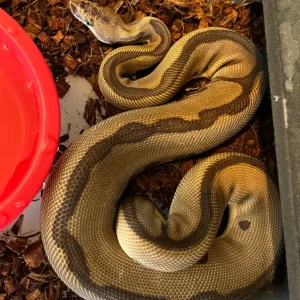
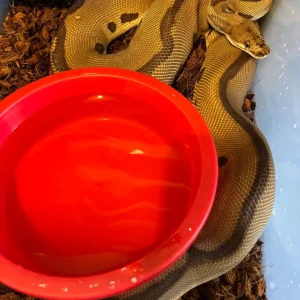
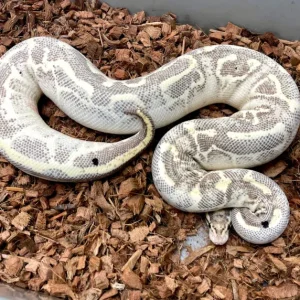
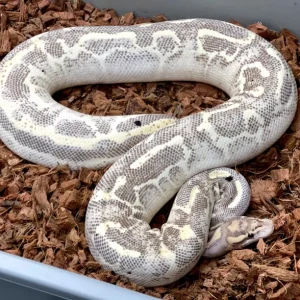
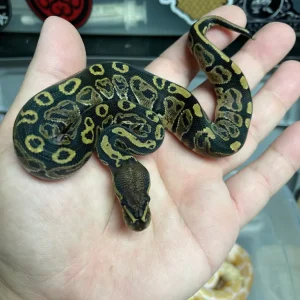
At birth, ball pythons are 25 to 43 centimeters long and grow to 1 to 1.5 meters as adults. There are some reports of ball pythons found in the wild reaching 1.83 meters in length. Their heads are larger than their relatively slender necks, and they are considered ponderous. The typical ball python has large brown markings with lighter mid-brown spots between the darker spots. They may also have yellow stripes from the nostrils to the eyes. The abdomen is generally ivory-white. Adult female ball pythons are larger than adult males. This sexual dimorphism is not present in newborns but is visible in adults. Adult females also have longer jaws than their male counterparts. The resulting increase in swallowing capacity may enhance their hunting ability.
Development
Juvenile ball pythons measure between 25 and 43 centimeters, while adults measure between 0.9 and 1.5 meters. The gestation period is approximately 44 to 54 days. Most ball pythons lay their eggs during the second half of the dry season, from mid-February to early April. The eggs are then incubated from mid-April to mid-June. Approximately three weeks after ovulation, a female ball python begins to shed her skin. The eggs are laid approximately four weeks later.
Lifespan/longevity
The average life expectancy of ball pythons in captivity is 20 years. The maximum life expectancy in captivity reportedly ranges from 28 years (at the Oakland Zoo) to 50 years (reported by the Philadelphia Zoo). The average life expectancy in the wild is reportedly 10 years.
Behave
Ball pythons move in a straight line, propelled by bilateral symmetrical contractions while pressing against the surface. Ball pythons are known for their defensive mechanism of “balling,” in which they form a tight ball with their head in the center in response to threats, thus giving them their common name “ball python.”
Communication and perception
Vision plays an important role in a ball python’s ability to capture prey. Studies of these snakes’ behavior in bright light have shown that ultraviolet activity may be a factor in prey capture. Other research suggests that ball pythons may follow the scent trails of their mammalian prey because these trails reflect ultraviolet light.
Eating habits
Ball pythons are carnivores and have movable upper and lower jaws. They use chemical and visual cues to hunt for their prey. Ball pythons sit and wait to ambush prey. As heavily built snakes, they are less active and instead choose good ambush sites. Their feeding strategy is to retract their head and neck and strike quickly. After the swift strike, they swallow their prey alive or immobilize it by grasping it. They feed almost exclusively on rodents and eat infrequently. Infrequent feeders have adapted by possessing the ability to largely regulate their gastrointestinal function through feeding and fasting. Ball pythons hunt rodents and are critical for controlling these pests, especially in rural communities. Rodent prey includes African giant rats (Cricetomys gambianus), black rats (Rattus rattus), red-nosed rats (Oenomys species), shaggy rats (Dasymys species) and grass mice.