Buy Bengal Cats in United States
Buy a Bengal cat in United States. For most cat lovers, spots mean “wild,” and spotted cats attract attention. While there are other spotted breeds, only the Bengal cat takes this a step further with its distinctive rosettes and dark outlines, giving it a unique appearance. Although they descend from a wild ancestor, these exotic-looking cats are the result of many generations of careful breeding aimed at reproducing the appearance of a wild cat and combining it with a lovable personality. Selection of the best temperaments was always a priority in the development of the breed. As a result, today’s Bengal cat is an exceptionally beautiful animal who is as playful and affectionate a companion as one could wish for. They also offer a true variety of colors and patterns to choose from.
Breed history
Two independent goals led to the creation of the Bengal cat. In 1963, conservationist Jean Mill, working to protect a small, tree-dwelling wild cat, the Asian leopard cat, crossed a black domestic tomcat with an Asian cat. Meanwhile, Dr. Willard Centerwall began a breeding program to produce similar crosses to create a domestic cat with the Asian cat’s natural immunity to feline leukemia. Mill then acquired breeding cats from Centerwall and used them alongside spotted domestic cats to create the Bengal cat. She ultimately bred docile cats that were five generations different from the original wild cats. The new breed gradually gained recognition in the cat world and enjoyed popularity both in the show ring and as pets. The CFA accepted Bengal cats for registration in 2016, provided they were descended from five generations of pure domestic cats. In 2018, they were declared Championship.
Characteristics
Bengal cats are confident, curious, and athletic. They are extremely intelligent and retain their kitten-like energy and behavior well into old age. They are fascinated by water and may enjoy watching you brush your teeth or even try to shower with you. They are easygoing and affectionate, easily trainable, and often learn tricks. Many enjoy walking with a harness and leash.
Bengal cats are often considered very talkative, but this isn’t necessarily true for all of them. There are big differences between individual cats: some enjoy chatting, others prefer to keep their thoughts to themselves. With proper introduction, they get along well with other pets and enjoy being part of a family. Their curious and affectionate nature also makes them a good choice for families with children.
Physical characteristics
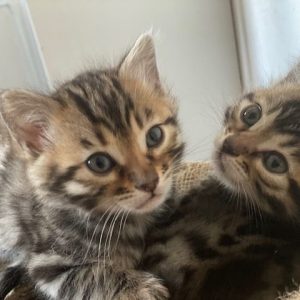
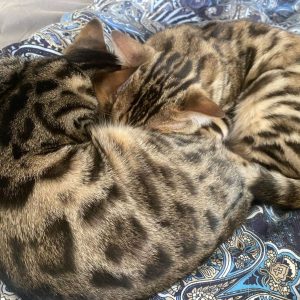
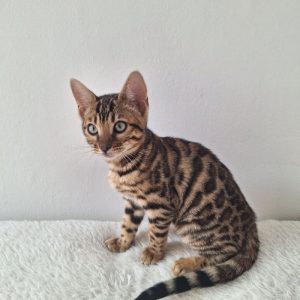
Watching the muscular, powerful body of a Bengal cat in action is like experiencing poetry in motion; it combines elegance and grace with athletic prowess. Most striking to many, however, is the unique head structure with its distinctive facial markings, large, bright eyes, broad nose, and pronounced whisker pads. The ears are small to medium-sized, which emphasizes the eyes and further enhances the fierce look. The most well-known color and pattern is the brown spotted or rosette tabby. Bengal cats also come in the mottled pattern. This is based on the classic tabby pattern but has a more distinctive, less symmetrical pattern with dark outlines, rich inner color, and speckles. Some Bengal cats have “glitter,” a sparkle visible at the tips of the hair when light shines.
Future of the breed
Genetic testing allows Bengal cat breeders to screen cats for a variety of hereditary diseases and remove carriers of these diseases from the breeding program. However, hypertrophic cardiomyopathy, the most common heart disease in cats, is only detectable by an echocardiogram. Most breeders have their breeding cats examined by a cardiologist before the first litter and repeat the process at regular intervals thereafter. This commitment to regular testing allows Bengal cat breeders to build a diverse and healthy gene pool.