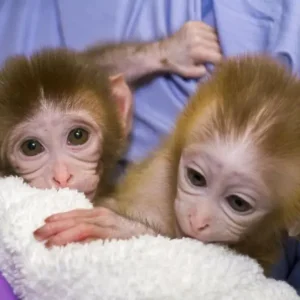
Buy Macaque Monkeys in United States
Buy Macaque Monkeys in United States. The body fur of long-tailed macaques is usually grayish-brown to reddish-brown. These colors are increasingly paler ventrally. The face is brownish-gray with whiskers. The eyes are directed forward to allow binocular vision. The nose is flat, and the nostrils are narrow and close together (catarrhine condition). Long-tailed macaques have shovel-shaped incisors, prominent canines, and bilophodont molars. The dental formula is I 2/2, C 1/1, PM 2/2, and M 3/3.
The body length without the tail is 40 to 47 cm. The gray-brown or reddish-colored tail is 50 to 60 cm long. Long-tailed macaques exhibit sexual dimorphism in size. The average weight for males is 4.8 to 7 kg and for females 3 to 4 kg, approximately 69% of the average weight of a male.
Lifespan/longevity
Although the lifespan of this species is unknown, it is likely similar to that of other members of the genus, which can reach a maximum age of about 30 years in captivity.
Home area
The average daily home range of this species is 1,900 square meters. The total area of all daily home ranges, or the home range of this species, averages 125 hectares.
Communication and perception
As with other species of the genus Macaca, these animals probably use a combination of visual (facial expression, body posture), acoustic (vocalizations), physical (grooming, play, mating, aggression) and possibly chemical (olfactory) signals as part of their communication repertoire.
Eating habits
Long-tailed macaques are omnivores and consume many different food types, reflecting the diversity of habitats they can use. The average feeding session lasts 18.3 minutes, and they can average twenty bouts per day. They eat a wide variety of foods, including fruits, crabs, flowers, insects, leaves, mushrooms, grasses, and clay. Clay can be eaten for its potassium content, although the potassium content in clay is low. However, they spend 96% of their daily feeding time eating fruit. Some limited observations suggest that cynomolgus macaques select fruit based on its ripeness, which in turn is based on color.
Predation
Predators of this species have not been reported.
Roles in the ecosystem
To the extent that these animals are prey for other species, they can influence the populations of those species. Macaca fascicularis can be an important predator in its ecosystem and exert some influence on prey species.
Economic importance for people: Positive
Crab-eating macaques, along with other macaque species, have been of benefit to humans through their use as research models in immunology, surgery, toxicology, and pharmacology. They are also important members of ecosystems and can serve as the basis for ecotourism projects. They are still sometimes hunted as a food source.