Buy Galahs in United States
Buy a Galah in United States. The Galah, best known by its native Australian name, “Galah,” is the perfect parrot species for a pet owner who enjoys frequent interaction with a pet bird. This beautiful pink bird is extremely intelligent and extremely affectionate. With regular training, it can easily learn many words and perform complicated tricks. This hardy bird can live in some of Australia’s more extreme environments.
Origin and history
The galah is native to Australia, where it can be found in open grasslands and across much of the country. It has also established itself in Tasmania. Galahs travel in large flocks, often in groups that also include sulphur-crested cockatoos. They mate with other cockatoo species.
Galahs are a familiar sight in urban areas. These birds tend to be more common in populated areas because they feed on cultivated crops and use artificial ponds and livestock watering holes. Many farmers consider the birds pests.
The name “galah” means “fool” or “clown” in the Australian language Yuwaalaraay. This highly intelligent bird was named because it was a noisy nuisance. The term “galah” is a slang, derogatory term in Australia, meaning “noisy idiot.”
temperament
The galah is affectionate and friendly and has a reputation for being a loving pet. Unlike white-crested cockatoos, these birds are not particularly cuddly. But they are used to being handled.
If you’re interested in a galah, make sure you have plenty of free time to spend with your pet. They’re a sensitive bird that demands a lot of attention and interaction from their owners. Because they’re a flock bird by nature, the galah can become depressed, angry, and destructive if their adopted human flockmate ignores them.
Language and vocalizations
Wild galahs emit loud, high-pitched calls when flying in flocks. They may emit a resonant screech when frightened, excited, or asking for attention. This clever bird can imitate human voices and repetitive sounds such as train whistles, car horns, or telephone rings. Some say that males talk more than females.
In comparison, the galah isn’t particularly loud for a cockatoo, and is among the loudest parrots. Nevertheless, this bird isn’t suited to living in an apartment or flat. It typically has two loud periods, once when waking with the sun and once at dusk.
Colors and markings of the galah
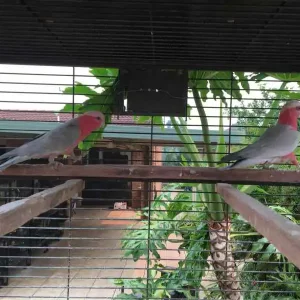
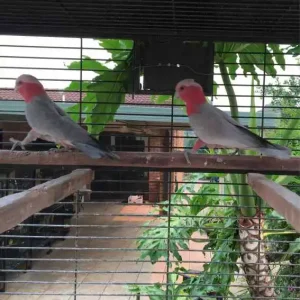
Their vibrant colors and friendly nature have made galahs increasingly popular as pets. As their descriptive name suggests, galahs have bright pink feathers on their chest, belly, and the lower half of their face. They have pinkish-white feathers and gray backs, wings, and tail feathers, gray feet, and horn-colored beaks. Like all cockatoos, the galah has a crest on its head that fans out when the bird is frightened or excited.
The easiest way to determine the sex of a galah is to look at its eyes. Males have a darker, almost brown iris (the area of the eye surrounding the pupil), while females have a lighter, pinkish iris. Anecdotally, males talk more, and females tend to perch with their legs wider apart.
Caring for a Galah
Your bird will want to spend a lot of time with you and will be a relatively high-maintenance pet. If you have little time for interaction, this bird may be happier housed with another galah.
These parrots need a sound sleep in a dark, quiet place that mimics the safety of the sleeping areas they prefer in the wild. Covering the bird’s cage at night usually calms them.
This bird isn’t a large parrot, but it still needs a lot of space. It needs a cage of at least 1.50 m².
Common health problems
Galahs appear to be less susceptible to avian diseases than other cockatoos. However, they are just as susceptible to nutritional disorders as other parrots and cockatoos. The most common conditions include fatty liver disease, lipomas (fatty tumors), parrot beak and feather disease (PBFD), feather plucking, and other forms of self-mutilation (if they feel neglected).
By far the most common problem in galahs is obesity. This is almost always caused by a lack of exercise combined with a high-calorie diet. With sufficient exercise and a balanced diet, your galah should maintain a healthy weight.