Buy Toyger Cat United States
Buy Toyger Cats in United States. The Toyger is a friendly, sociable cat with an ideal temperament and character. Toygers are a great addition to families with children or pets and are eager to play and show affection.
If you’re looking for a cat that needs below-average exercise, the Toyger’s energy level may not be right for you. Because of their intelligence, they’re prone to boredom, so playtime is essential. Toygers are trainable and can learn tricks.
History of the Toyger cat
In the 1980s, breeder Judy Sugden (daughter of the original Bengal cat breeder, Jean Mill) was working with tabby cats—cats characterized by their wild stripes and an “M”-shaped marking on their foreheads. Sugden noticed that her Bengal cat, Millwood Sharp Shooter, had round spots on its head instead of the typical “M” shape. The spots made Sugden realize it was possible for him to breed a domestic cat that closely resembled a tiger.
Sugden then launched a breeding program with two cats: Scrapmetal, a short-haired tabby domestic cat, and Millwood Rumpled Spotskin, a large-boned Bengal cat. In 1993, Sugden imported Jammie Blu (a street cat from Kashmir, India, with the characteristic, unusual spots between his ears), added him to the breeding pool, and accelerated the program. Pioneering breeders Anthony Hutcherson and Alice McKee joined Sugden’s project later that year. The International Cat Association accepted the Toyger for registration and listed it as a championship breed in 2007, cementing its eligibility for cat shows.
Care of Toyger cats
Caring for a Toyger is standard for most domestic cats. Because of their friendly nature, playtime and grooming should be straightforward for both owner and cat.
Care
Although Toygers are short-haired cats, they shed heavily and should be brushed weekly. Teeth brushing, ear cleaning, and regular nail trimming are also essential.
Movement
Toyger cats are naturally active and require regular exercise. Because of their high trainability, you can teach your Toyger to walk and fetch on a leash. However, leash walking is not a requirement. Toygers are typically active indoors, so independent playtime can be sufficient exercise.
Common health problems
The Toyger is a relatively rare breed, so knowledge of its health issues is limited. However, it is believed that Toygers may be at increased risk for heart murmurs.1 Make sure your Toyger receives regular checkups, receives preventative care, and is vaccinated.
Look
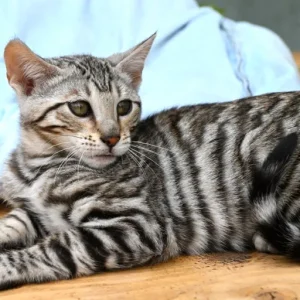
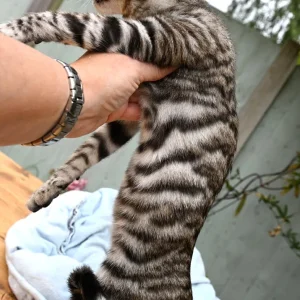
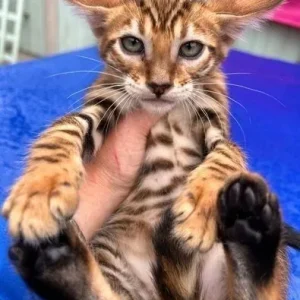
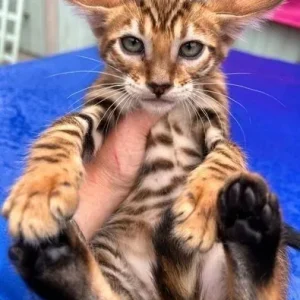
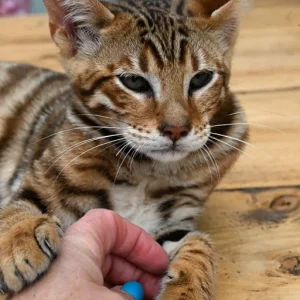
Toygers have a distinctly tiger-like appearance, characterized by broken, vertical orange and black or brown-bordered stripes. The International Cat Association describes the markings as “dark markings on a bright orange background on the outer and upper parts of the cat, with a white base color on the underside and inside… highlighted by the scattering of gold glitter on the upper parts.”2 Each cat’s markings are different. Unlike the mackerel stripes or round rosettes of a tabby cat, a Toyger’s coat pattern is random. The ideal Toyger head features circular markings not found on any other domestic cat breed. The short, uniquely patterned coat is not hypoallergenic.
The shape of a Toyger’s head in profile is described as “half a hexagon.” Toyger cats are long, lean, and muscular, but not massive, with a long, thin tail with a rounded tip. They have small, round ears and bright green or blue eyes. The nose is broad at the base, with the jaw area correspondingly wider. Male Toygers tend to be larger, more muscular, and heavier than female Toygers.
Nutrition and nutrients
The nutritional requirements for Toygers are the same as for any short-haired domestic cat. Obesity can shorten your cat’s lifespan, so discuss the best diet plan with your veterinarian. Feed your Toyger high-quality wet and dry food and provide access to fresh, clean water. If you want to give your Toyger a treat, a small piece of meat (e.g., poultry, beef, fish, venison, lamb) is always a good option.