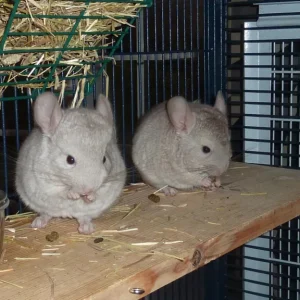
Buy Chinchillas in United States
Buy Chinchillas in United States. The Chinchilla lanigera has a head and body length of 225–380 mm and an average tail length of 75–150 mm. The species is sexually dimorphic, with females weighing up to 800 g and males only 500 g.
The fur of members of this species is extremely dense and soft. Each hair usually has a black tip, and up to 60 hairs grow from a single follicle. The underside is usually bluish, pearly, or brownish gray, and the belly is yellowish-white. The tail is furry, with coarse hairs on the dorsal surface.
The head is broad and the outer ears are large. Chinchillas have large, black eyes with vertically divided pupils, vestigial cheek pouches, and incisors with colored enamel. Both the front and hind feet have four toes with stiff bristles surrounding the weak claws.
Behave
Female chinchillas are the dominant sex and are very aggressive toward each other and toward males during estrus. Despite this aggressiveness, serious fights are rare in the wild. Chinchilla lanigera express threats through growling, teeth chattering, and urination.
Chinchillas are social animals and live in colonies of more than 100 individuals. They are primarily nocturnal, with peaks of activity at dusk. However, on sunny days, C. lanigera has been observed sitting in front of its hole, climbing and jumping on rocks with astonishing agility.
Domesticated chinchillas are very social and can be hand-tamed to play and interact with their owner.
Eating habits
Long-tailed chinchillas are primarily leaf eaters, feeding on many types of vegetation, but primarily grasses and seeds. They may also opportunistically eat insects and bird eggs. While feeding, C. lanigera sits upright and holds the food in its front paws.
Domesticated chinchillas are fed alfalfa, hay, wheat, corn, oats, and commercially available feed pellets.
Economic importance for people: Positive
Chinchillas have been hunted for their clothing since the early 20th century. Around 1900, an estimated 500,000 chinchilla pelts were exported annually from Chile. Chinchilla pelts are considered by some to be the most valuable furs in the world, and coats have sold for up to $100,000. International trade in wild chinchillas or their pelts is now restricted by the Convention on International Trade in Endangered Species (CITES).