Buy Galagos United States
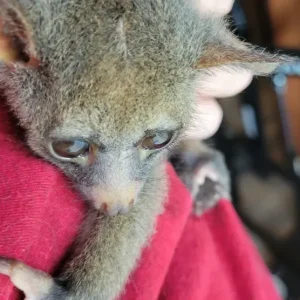
Buy Galagos in United States. Bush babies (family Galagidae), any of more than 20 species of small, attractive arboreal primates native to sub-Saharan Africa. They are gray, brown, or reddish to yellowish-brown, have large eyes and ears, long hind legs, soft, woolly fur, and a long tail. Bush babies are also distinguished by the long upper part of their feet (tarsus) and the ability to fold their ears. They are nocturnal and feed on fruit, insects, and even small birds, but a major component of the diet of most species is gum (tree exudate). They obtain this by drilling holes in trees with their toothcombs (forward-tilting lower incisors and canines) and scraping away the bark. Galagos cling to trees and leap between them; the smaller forms, such as the Lesser Bush Baby (Galago senegalensis), are extremely active and agile. When they descend to the ground, they sit upright and move by hopping on their hind legs like jerboas. The gestation period is about three to four months; the young are usually numbered one or two.
Lifespan/longevity
The maximum lifespan of dwarf galagos in captivity is 16.5 years. It is thought that they can live to 14 to 16 years in the wild, but further research is needed to confirm this. As with many other primates, their lifespan is limited by aging. Due to their small size, dwarf galagos age faster than larger primates. (Austad, 1997)
Behave
Dwarf galagos live primarily in trees, although they occasionally forage on the ground. They move through low forest trees by walking on all fours or hopping with their long, powerful hind feet. Dwarf galagos have long fingers and fingertips that help them navigate branches.
Dwarf galagos are crepuscular and nocturnal. They are most active shortly after dusk and before dawn, but also at night. Females are usually territorial and disperse evenly across suitable environments. Males are often active near female territories, although this is not always the case. Dwarf galagos urinate on their hands and feet, most likely to mark their territory and possibly to cling to branches. Although dwarf galagos tend to forage alone, females have been observed foraging in small social groups of up to six individuals. Females also roost in communal nests with other females. The social systems of dwarf galagos are poorly understood, so no detailed information on social hierarchies is available.
Dwarf galagos lapse into brief periods of torpor in cold temperatures, but they have several behavioral adaptations that they frequently use to escape adverse conditions. For example, they often select isolated resting sites and huddle in small groups to keep warm. Dwarf galagos generally roost in areas with high canopy cover and good canopy vegetation connectivity. They also select areas with more medium-height vegetation cover, higher tree density, and a larger number of acacia trees (genus Acacia).