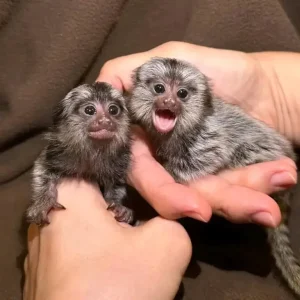
Buy Finger Monkey United States
Buy Finger Monkeys in United States. As the name suggests, these cute animals are true monkeys. They are the smallest species of monkey and one of the smallest primates in the world. Their official name is pygmy marmoset. Like other common marmosets, they live high in the treetops of South American rainforests. All common marmosets are relatively small, but the pygmy marmoset grows no more than 11.7 to 15 cm long, not including its tail, which can measure between 17.5 and 23 cm. Females are typically slightly larger than males, weighing just over 113 grams on average. Baby pygmy marmosets are so small that they can cling to your finger, much like other monkeys cling to branches; hence the nickname.
They are sometimes called thumb monkeys, pocket monkeys, and little lions, the latter due to the fur that surrounds their heads like a mane. Although finger monkeys are not considered an endangered species, they are affected by habitat destruction. Their adaptability to new environments may prevent them from being placed on the endangered species list.
The life of a finger monkey
Finger monkeys are social creatures that live in small groups in the wild, generally consisting of an adult male, an adult female, and their offspring. Groups range in size from as few as two to as many as nine or ten individuals. Females can give birth twice a year and usually have twins each time, although single or triple births do occur. Males carry the newborns to term and care for them for the first two weeks of life. Although the species is largely monogamous, groups may include an additional male to assist with newborn care. Young finger monkeys also contribute to the care of the babies.
In the wild, a finger monkey has an average life expectancy of 12 to 16 years. In captivity, this range increases to 15 to 22 years. Studies suggest that only a quarter of all babies born in the wild survive to adulthood. Most succumb to falls from trees or from the group member carrying them.
These tiny creatures have long, sharp nails, more like claws than the flat nails of other primates. These allow them to brace themselves vertically in trees while using their long, narrow teeth to feed on sap. Finger monkeys also eat resin, gum, and tree vines. Small insects, butterflies, spiders, and fruit round out their diet.
They can turn their heads up to 180 degrees to scan for danger and leap up to 16 feet to escape. Their natural enemies include snakes, cats, and birds of prey. They use their leaping ability, along with vocalizations, group attacks, and even freezing in place, to ward off intruders.
Finger monkeys are active during the day and rise shortly after sunrise, unless the day is cloudy or rainy. They spend their time eating, foraging, grooming, and playing. After their second feeding, the group returns to their sleeping area or roost. The roost is usually a clump of vines, but sometimes consists of tree hollows.
Can I keep a finger monkey as a pet?
Now that you have some background information on finger monkeys, what should you consider when deciding whether to adopt one as a pet? First, you should check whether it’s legal in your state to keep primates, and specifically monkeys, as pets. More than half of all states and the District of Columbia prohibit the private ownership of monkeys entirely or only allow it with a special license, permit, or exemption from the state, county, or municipal government.
These tiny marmosets have become popular as pets in the United States due to their small size and cute faces. However, they are still wild animals. As mentioned above, they burrow into tree bark with their long teeth to find food. This makes their bite painful, though it is generally not dangerous, especially to children and other pets. Finger monkeys are known to be aggressive, especially males when fully grown. Like other monkeys, they are known to leave droppings when they become angry.
How to care for a finger monkey as a pet
These are intelligent animals, and their early years leave a big impression. The good and bad habits they pick up during this time will stay with them for life, so you’ll need to invest a lot of time in training them when they’re young.
It’s important to recreate a finger monkey’s natural habitat in captivity. A large cage with trees, vines, water, and swings will allow them to jump, climb, and play as they would in the wild. Direct sunlight is preferable, but a heat lamp or other artificial light source can be attached to the cage if natural light isn’t regularly available. Some breeders include a “starter” cage kit with the purchase of a finger monkey. Provide their nutrition by giving them access to trees, fruits, vegetables, and insects. Babies need to be fed every two hours.
You should buy or adopt finger monkeys at least in pairs. Even ample human companionship isn’t enough to keep these social animals mentally fit. Companionship within the same species is essential for their well-being.