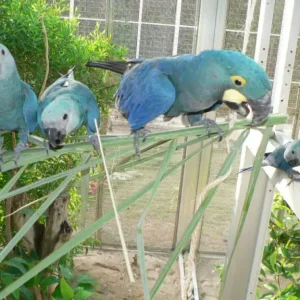
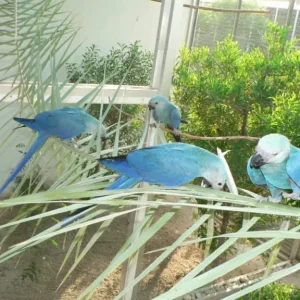
Buy Macaw Parrots in United States
Buy Macaw Parrots in United States. They are a group of long-tailed and often colorful parrots from the New World, belonging to the tribe Arini. They are popular in aviculture or as companion parrots, although there are conservation concerns for several species in the wild.
Of the many different genera of Psittacidae (true parrots), six are classified as macaws: Ara, Anodorhynchus, Cyanopsitta, Primolius, Orthopsittaca, and Diopsittaca. Formerly, members of the genus Primolius were placed in Propyrrhura, but the former is correct according to ICZN rules.[2] In addition, the related, macaw-like Thick-billed Parakeet is sometimes referred to as a “macaw,” although phylogenetically it is not considered a species of macaw. Macaws are native to Central America and North America (only Mexico), South America, and formerly the Caribbean. Most species are associated with forests, but others prefer woodland or savanna-like habitats.[3]
Relatively larger beaks, long tails, and relatively bare, light-colored medial areas (facial patches) distinguish macaws from other parrots. Sometimes the facial patch is smaller in some species and, in members of the genus Anodorhynchus, is limited to a yellow patch around the eyes and a second patch near the base of the beak. The facial feather pattern of a macaw is as unique as a fingerprint.[4]
The largest macaws are the Hyacinth, Buffon (Great Green), and Green-winged Macaws. Although still relatively large parrots, miniature macaws of the genera Cyanopsitta, Orthopsittaca, and Primolius are significantly smaller than members of Anodorhynchus and Ara. The smallest member of the family, the Red-shouldered Macaw, is no larger than some parakeets of the genus Aratinga.[3]
Nutrition and clay licks
Macaws and Southern Mealy Amazons at a clay lick in Tambopata National Reserve, Peru.
Macaws feed on a wide variety of foods, including seeds, nuts, fruits, palm fruits, leaves, flowers, and stems. Safe vegetables include asparagus, beets, bell peppers, broccoli, butternut squash, carrots, corn on the cob, dandelion greens, collard greens, hot peppers, spinach, sweet potatoes, tomatoes, and zucchini. Wild species can migrate long distances in search of seasonally available food, over 100 km (62 miles) for some of the larger species such as Ara araurana (Blue-and-yellow Macaw) and Ara ambigua (Great Green Macaw).
Some foods that macaws eat in the wild in certain regions are said to contain toxic or corrosive substances that they can digest. It is thought that parrots and macaws in the Amazon basin eat clay from exposed river banks to neutralize these toxins.[13] In the western Amazon, hundreds of macaws and other parrots descend to exposed river banks to eat clay almost daily—except on rainy days.[14][15] Donald Brightsmith, the Macaw Society’s senior researcher at the Tambopata Research Center (TRC) in Peru, has studied the clay-feeding behavior of parrots at clay licks in Peru. He and his colleagues found that the soils the macaws eat at the clay licks do not have a higher cation exchange capacity (ability to absorb toxins) than unused areas of the clay licks,[16] and therefore the parrots cannot use the clay to neutralize ingested food toxins.
Rather, the macaws and other bird and animal species prefer clay with a higher sodium content.[17] Sodium is an essential element that is rare in environments more than 100 kilometers from the sea.[18] The distribution of clay licks in South America further supports this hypothesis – the largest and most species-rich clay licks are located on the western side of the Amazon basin, far from oceanic influences.[19] Salt-enriched (NaCl) marine aerosols are the main source of sodium in the environment near the coast and decrease drastically inland.
Relationship with people
Macaws and their feathers have attracted human attention throughout history, particularly in pre-Columbian civilizations such as the Inca, Wari, and Nazca. Macaw feathers were highly sought after for their vibrant colors and were acquired through hunting and trade.[22] Feathers were often used as ornaments and were found at both ceremonial and burial sites. South American weavers have used their feathers to create a variety of textiles, particularly feather panels and tabards.
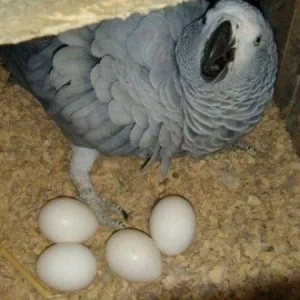
African Grey Parrots