Buy Hyacinth Macaw United States
Buy Hyacinth Macaws in United States. Anodorhynchus hyacinthinus prefers semi-open habitats. These are typically forests with a dry season that prevents the growth of extensive, tall, closed-canopy tropical forests. Blue macaws live in a variety of habitats, including deciduous forests, cerrados, and palm groves, as well as the palm savannas of the Pantanal. The Pantanal is a particularly important habitat for macaws as it is a large, lush oasis in southern Brazil.
Physical description
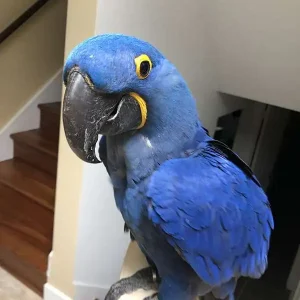
The largest of all parrots, blue macaws are 95 to 100 cm (37.5 to 39.5 inches) long, although the tail accounts for half that length. They weigh approximately 3.5 pounds (1,200 to 1,700 g) and have a wingspan of 117 to 127 cm (46 to 50 inches). Macaws typically lack feathers around the eyes and in fairly large patches on the side of the head. Anodorhynchus hyacinthinus, on the other hand, has only a small ring around the eye and around the base of the lower mandible, which are bare, revealing the distinctive, bright yellow skin.
Blue macaws are a uniform ultramarine blue that is rich and glossy. The beak of blue macaws is massive, black, and curved. Like most parrots, they use their beak as a third leg for clinging to trees, which is helpful when climbing. They have short, powerful legs that are useful for hanging sideways and upside down. Male and female blue macaws are alike.
Behave
Blue macaws are very sociable birds. They court, mate, and bond throughout the year. They are usually seen in pairs. They are most active from morning to afternoon and fly to and from feeding grounds in groups of two to eight. After feeding, they return to their roosting trees around sunset to spend the night. Blue macaws are often described as gentle giants with a gentle and affectionate nature.
Eating habits
Blue macaws are equipped with large beaks that they use to crack open the shells of nuts. These nuts are usually quite hard, so the bird first uses its beak to file away the thickness of the shell in one place and then snaps it cleanly in half. Their large, hooked beak is remarkably efficient compared to other macaws. Blue macaws feed on eight species of palm nuts, which are rich in nutrients and fat. Two of the palm species are Acrocomia iasiopatha and Astryocaryun tucuma. They depend largely on palm nuts but will occasionally feed on small seeds, palm shoots, and snails. Feeding is mainly on the ground, although macaws use their climbing ability to pluck palm nuts from the clusters inside trees. Blue macaws will also eat palm nuts that have wandered through the shells of cattle.
predators
The main predators of the blue macaw are egg robbers: jays and crows (family Corvidae), coatis (genus Nasua), toucans (family Ramphastidae) and skunks (subfamily Mephitinae).