Sulphur-crested Cockatoo for sale in United States
Sulphur-crested Cockatoo for sale in United States. Cacatua galerita is native to the Australian region and occurs in large numbers in northern and eastern Australia. It has been introduced to Western Australia, New Zealand, and New Guinea.
habitat
Sulphur-crested cockatoos live in a variety of wooded habitats, including tropical and subtropical rainforests. They are also found in the vast savannas of northern Australia. Sulphur-crested cockatoos are also found in suburban and urban areas, particularly in parks and gardens.
Physical description
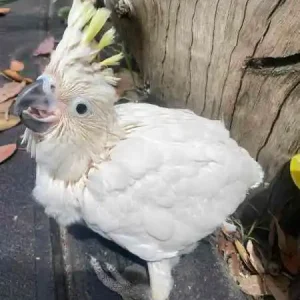
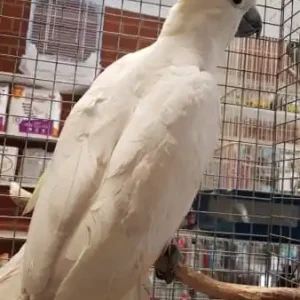
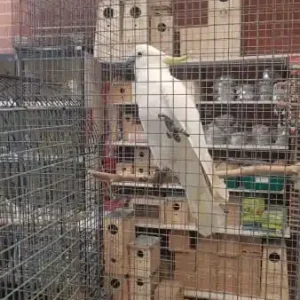
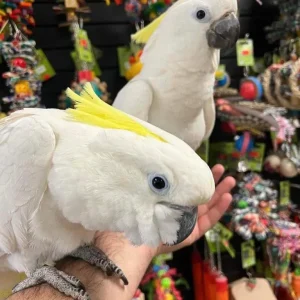
Sulphur-crested cockatoos are large birds, measuring 45 to 50 centimeters in length. They average 800 grams. Sulphur-crested cockatoos are white with a distinctive sulfur-yellow crest that can be held erect or folded on top of the head. The underside of their wings and tail is pale yellow. Females and males are similar in appearance (monomorphic); however, females can be identified up close by their red-tinged brown eyes, while males have darker brown eyes. There are four subspecies of sulphur-crested cockatoos. Cacatua galerita fitzroyi differs from C. g. galerita in having a light blue eye ring instead of a white one, the yellow feathers are slightly darker, and the crest feathers are longer. Cacatua galerita eleonora and C. g. triton are both smaller on average than C. g. galerita.
Lifespan/longevity
Sulphur-crested cockatoos can live for decades in the wild. The average life expectancy is about 40 years, but they can live up to 100 years. In captivity, well-cared sulphur-crested cockatoos can live an average of 65 years and up to 120 years.
Behave
Cacatua galerita is a gregarious species, often forming flocks of a dozen to several hundred birds. When foraging, these large flocks often split into small groups and reconvene at the roost in the evening. Feeding often occurs on the ground, and in such situations, some of the flocks act as sentinel birds in trees, warning the flock of approaching danger. Sulphur-crested cockatoos generally remain sheltered during midday and resume feeding in the late afternoon and evening before drinking and returning to the roost.
The characteristic raspy call of C. galerita is very loud; it is said to span great distances through the forest environment. The cacophony produced by a large flock of Sulphur-crested Cockatoos can be deafening.