Buy flying squirrels in United States
Buy flying squirrels in United States. Southern flying squirrels grow to a maximum length of 285 mm (range: 200–285 mm) and a maximum weight of 90 g (range: 38–90 g). According to Whitaker Jr. and Hamilton Jr. (1998), measurements of 64 individuals in Indiana yielded an average of 228 mm total length, 100 mm tail, 31 mm hind foot, and 63 grams in weight. Another set of measurements, reported by Whitaker Jr. and Hamilton Jr. (1998), taken from 66 individuals in Florida yielded an average of 221 mm total length, 100 mm tail, 30 mm hind foot, and 52 grams in weight. Their ears are pink and hairless inside and covered with gray-brown hair outside. Each ear measures between 15 and 25 mm in total length.
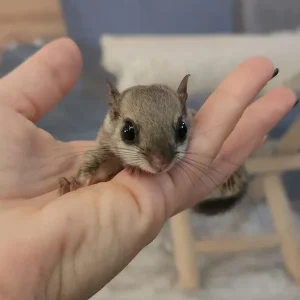
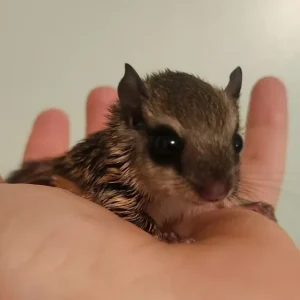
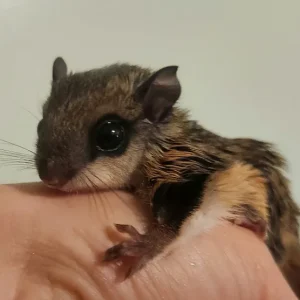
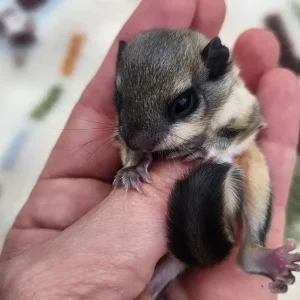
Southern flying squirrels have large eyes relative to their body size. The eyes are black and surrounded by black hair. The hair on their underbelly and under the nose is consistently whitish-cream, while the hair on the dorsal side and above the nose is grayish-brown at the tips and black at the base. Their front and hind feet are almost the same size, but the hind feet have five claws while the front feet have only four. They have 22 teeth, and their dental formula is 1023/1013.
Buy Flying Squirrels
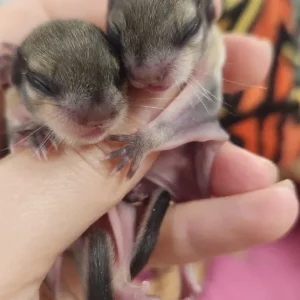
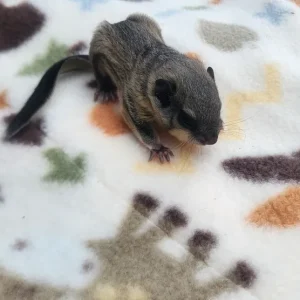
Newborn southern flying squirrels weigh a total of 3 to 5 grams and are completely hairless. Their eyes and ears are closed until about three to four weeks after birth, and they nurse until they are about five weeks old. After three weeks, they are covered in dense fur all over, except on their lower abdomen, which becomes densely hairy by the fourth week. Once young squirrels are six to eight weeks old, they can only be distinguished from adults by their size. Distinguishing between male and female southern flying squirrels can only be done by identifying their external genitalia. Males have a penis bone that averages 19 millimeters long. Both sexes have four pairs of nipples that run the entire length of the abdomen.
Lifespan/longevity
Southern flying squirrels have an average life expectancy of three to five years in the wild. Their average life expectancy increases to 10 years in captivity, with a maximum lifespan of 19 years.
Behave
Although squirrels are often thought to be confined to trees, southern flying squirrels move on the ground and on tree trunks while foraging. Southern flying squirrels are exclusively nocturnal and extremely active throughout the night during the summer months. However, during the colder months, their activity is limited to shortly after dusk and just before sunrise. During extreme cold, southern flying squirrels will remain in their nests for several days at a time. (Linzey, 1998; Schwartz and Schwartz, 1981; Whitaker Jr. and Hamilton Jr., 1998)
Southern flying squirrels are extremely sociable animals that gather in a nest during the winter months and communicate with each other throughout the night. Although these animals emerge from their nests at sunset, communication between the squirrels only occurs during astronomical twilight. Communication occurs through both ultrasonic frequencies and a variety of squeaking sounds similar to those of a bird. During the winter months, southern flying squirrels nest together in large numbers, sometimes up to 20 nesting together, for warmth.
Flying squirrels for sale
During the warmer months, this number decreases to an average of five squirrels per nest. These nests are always very clean, and each southern flying squirrel grooms itself meticulously. (Dolan and Carter, 1977; Linzey, 1998; Madden, 1974; Murrant et al., 2014; Muul, 1970; Schwartz and Schwartz, 1981; Weigl, 1978; Whitaker Jr. and Hamilton Jr., 1998)
Contrary to their name, southern flying squirrels don’t actually fly, but rather glide between trees using their patagium. Before gliding, southern flying squirrels move their heads from side to side to determine the distance to their target landing site. Once the distance has been estimated, they take off into the air, simultaneously spreading their arms and legs to taut the gliding membrane. The spread gliding membrane creates drag, allowing the squirrels to successfully cover distances of up to 28 meters, although most glides are between 6 and 9 meters long.
Slack can be created in the left or right membrane, allowing the squirrel to control the angle, speed, and course of its glide. Southern flying squirrels use their tails to steer through the various branches found between trees.