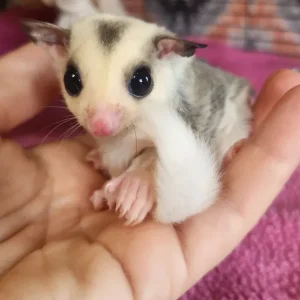
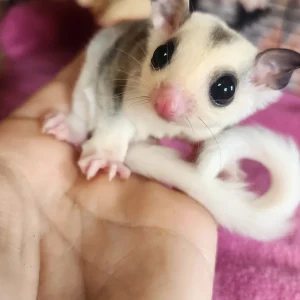
Buy Short-headed Gliders in United States
Sugar gliders for sale in United States. Sugar gliders can live in all types of forests, provided there is sufficient food. They build their nests in the branches of eucalyptus trees within their territory. Since they are also found in South Australia, they must be able to cope well with the cold.
Physical description
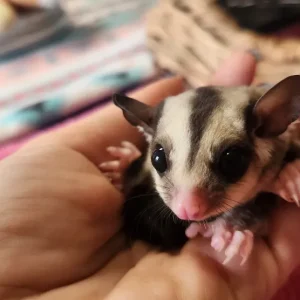
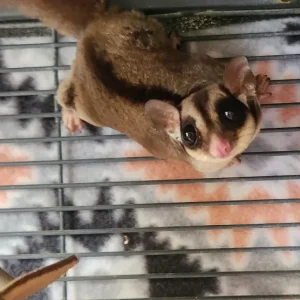
The short-headed glider is a relatively small marsupial; its head and body are about 120–320 mm long, and its tail is 150–480 mm long. Short-headed gliders are generally blue-grey on the back, while their ventral side is slightly paler. A dark stripe runs from the posterior end to the nose on the back, while there are similar stripes on both sides of the face, running from the eye to the ear. Similar to flying squirrels, short-headed gliders have a gliding membrane that extends from the outside of the forefoot to the ankle of the hindfoot and can be opened by spreading the limbs. The female short-headed glider also has a well-developed pouch.
Behave
Short-headed gliders are extremely active animals that can glide up to 45 meters (150 feet). They nest in groups of up to seven adult males and females and their young, all of whom are related. Short-headed glider groups are mutually exclusive and territorial. Each group defends a certain number of eucalyptus trees, which provide the group’s main food source. The adult males of the group regularly mark this territory with their saliva and with secretions from their anal, hand, and foot scent glands. Short-headed gliders also have scent glands on their foreheads and chests, which the males of a group use to mark all other members. In each group of short-headed gliders, there is usually one dominant male who is responsible for most of the territory and group marking. This male is usually heavier, produces more testosterone, and mates more frequently with the females of the group.
If another animal detects that it doesn’t belong in the group because it doesn’t have the group scent, it will be attacked immediately and violently. Within groups, no fighting occurs other than threatening behavior. Gliders can also communicate through the variety of sounds they can make, such as an alarm call that sounds like the bark of a small dog. The territory size of a group of gliders is about 2.5 hectares.
Eating habits
Short-headed gliders are omnivores. Short-headed gliders feed primarily on the sweet sap found in eucalyptus trees. Their diet also includes pollen, nectar, insects and their larvae, arachnids, and small vertebrates. During the spring and summer months, short-headed gliders feed primarily on insects, mainly moths and beetles, and during the fall and winter months, they feed on plant products such as eucalyptus sap and pollen.