Buy Tree Python United States
Buy Tree Pythons in United States. Morelia viridis reaches an average length of 1.5 meters; the largest known specimen was 2.2 meters long. The head scales are irregular and small, and their labial heat-sensing pits are located only in the scales on the upper lip. Their tails are adapted for grasping, which aids them in climbing. Green tree pythons do not appear to exhibit sexual dimorphism in adulthood; however, at smaller lengths, young females have both wider and longer heads compared to males of similar size.
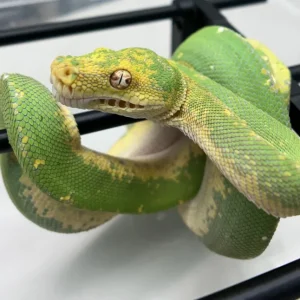
As adults, green tree pythons are bright green over most of their bodies. The dorsal surface has a distinct scale ridge, usually white to yellow in color, forming a broken or continuous line along the length of the body. On the ventral side, the scales are generally yellow. However, in some specimens, the ventral scales may be pale yellow to white and have a scattered blue tinge on the dorsal surface.
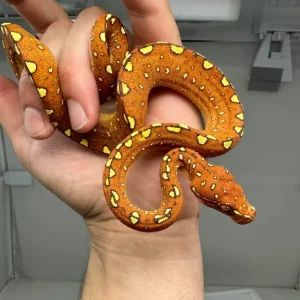
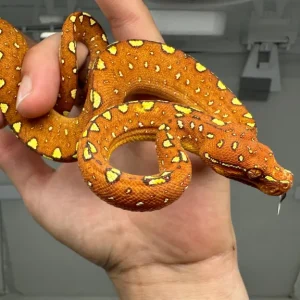
Juvenile green tree pythons can be either bright yellow or brick red. They have a row of white spots with black or brown borders on their dorsal surface. These spots can be arranged either symmetrically or randomly on either side of the body. In both color variants, a white stripe with a black border runs from the nostril through the eye and to the back of the head. The distribution of these two color variants appears to be distinct, although in captivity it is not uncommon to find both color variants in the same clutch. In the wild, only the yellow variant has been recorded in Australia. Although poorly studied, the red variant appears to be restricted to Biak Island and the Baliem Valley in Papua, Indonesia, and the Sepik Basin in Papua New Guinea. In some populations of Morelia viridis, adults may not completely change to green and retain some of their juvenile yellow coloration.
Lifespan/longevity
Information on the actual age of Morelia viridis in the wild is limited. However, a population in the Iron Range on the Cape York Peninsula in Australia had an average age of 3.4 years. It is predicted that these pythons could live to at least 15 years, with a maximum age of 19 years. Green tree pythons in captivity have lived only slightly longer, with the record age reported as 20 years.
Behave
Morelia viridis is the most commonly arboreal python species, although it is occasionally found on the ground. As adults, they are nocturnal and hunt primarily at night, although larger nocturnal prey may be active. Before the ontogenetic color change, green tree pythons are diurnal, coinciding with smaller prey that are active during the day.
Green tree pythons exhibit two distinct postures, depending on whether they are resting or hunting. In the resting position, the snake’s body is coiled and hanging from a horizontal branch or vine, which is how the animal is generally depicted in photographs. In the resting position, green tree pythons often seek shelter in tree hollows or epiphytic vegetation. In the hunting position, the front end of the body is extended from the branch and folded like an accordion, ready to strike the ground or a lower branch, while the rear end is tightly wrapped around the perch. Green tree pythons typically only change these positions during dusk or dawn to conceal their location.
Activity rates differ between the sexes. Females change their position more frequently from day to day than males. They are also more active and move farther in February. In contrast, males are more active in January and March. However, from around April until the beginning of the next breeding season in October, both sexes are sedentary and inactive. When moving, adult snakes travel the same distances as juveniles, regardless of their comparatively smaller size.